
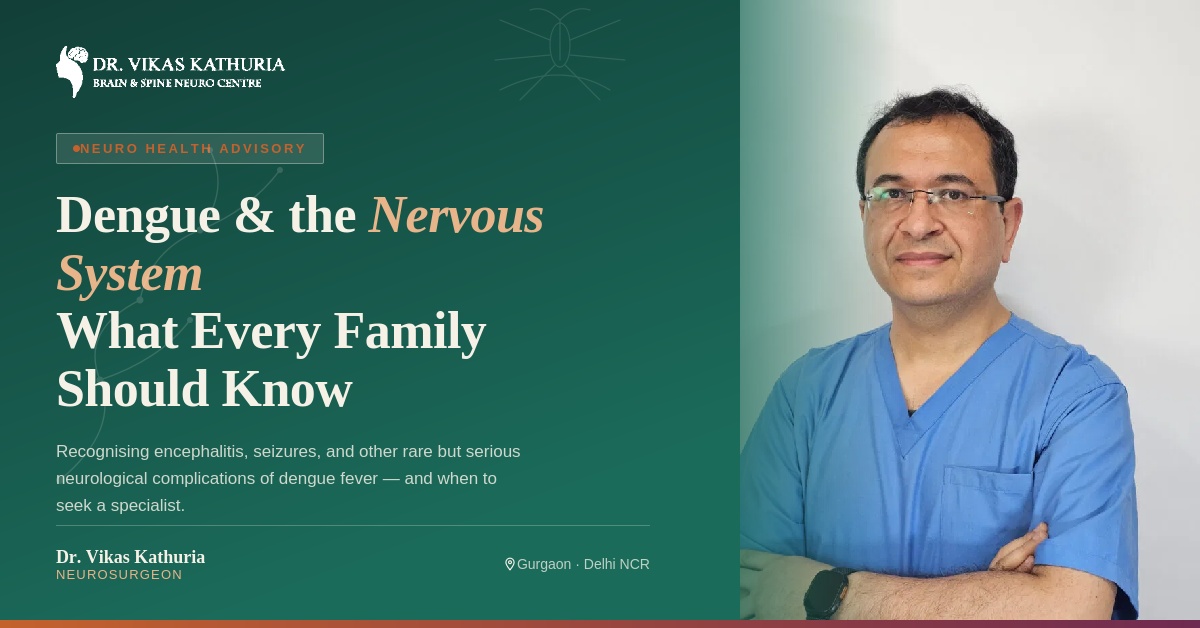
Dengue and Your Nervous System: When Should You See a Neurologist in Gurgaon & Delhi NCR?
Every monsoon, Delhi NCR sees a sharp rise in dengue cases, and this year is no different. Gurgaon, Faridabad, Noida, and Delhi hospitals are reporting an early and steep increase in dengue infections linked to heavy rainfall, waterlogging, and mosquito breeding across residential and commercial areas. Most people associate dengue with high fever, body ache, and low platelet counts — and rightly seek treatment from a physician. What often gets missed, however, is that dengue can also affect the brain and nervous system in a small but significant number of cases. This is where a neurosurgeon or neurologist evaluation becomes important, especially when symptoms go beyond the usual fever pattern.
As a neurosurgeon in Gurgaon treating patients from across Delhi NCR, Dr. Vikas Kathuria often gets referred cases where a dengue patient develops severe headache, confusion, seizures, or weakness that does not fit the typical viral fever picture. This blog explains how dengue can involve the nervous system, the warning signs you should never ignore, and when it is time to consult a specialist rather than wait it out at home.

Dengue Cases Are Rising Across Gurgaon, Delhi, Noida & Faridabad This Monsoon
Delhi NCR’s monsoon months bring waterlogged roads, stagnant water in coolers and construction sites, and the ideal breeding ground for Aedes mosquitoes that spread dengue. Municipal bodies across Gurgaon, Delhi, Faridabad, and Noida have flagged an early and unusually high number of larva-positive sites this season, and hospitals across the region are already reporting more dengue admissions than the same period last year. Health authorities have repeatedly urged residents to eliminate stagnant water around homes and offices and to seek medical attention quickly if fever persists.
While the vast majority of dengue cases resolve with rest, fluids, and monitoring, a subset of patients develop complications that extend beyond the typical fever-and-platelet-drop pattern. Neurological involvement is one of the more overlooked complications, partly because doctors and families are focused on managing fever and platelet counts, and partly because symptoms like headache and fatigue are assumed to be “normal” for dengue.
How Dengue Can Affect the Brain and Nervous System
Dengue is primarily known as a blood and vascular illness, but research and clinical experience have shown that the virus and the body’s immune response to it can also involve the nervous system. This is sometimes called “neuro-dengue.” The exact mechanism can involve direct viral invasion of brain tissue, immune-mediated nerve damage, or complications arising from bleeding, low blood pressure, or fluid shifts during severe dengue. Some of the recognised neurological complications include:
- Dengue Encephalitis – inflammation of the brain tissue, causing confusion, altered consciousness, or seizures
- Meningitis – inflammation of the membranes covering the brain and spinal cord, presenting with severe headache and neck stiffness
- Guillain-Barré Syndrome (GBS) – an immune-related nerve disorder that can develop during or after recovery from dengue, causing progressive weakness
- Seizures – which may occur due to high fever, brain inflammation, or bleeding
- Intracranial Bleeding – in severe dengue with very low platelet counts, spontaneous bleeding inside the brain is a rare but serious risk
- Stroke-like Presentations – transient weakness or vision disturbance due to vascular involvement
- Post-dengue Fatigue and Cognitive Symptoms – some patients report persistent brain fog, low mood, or difficulty concentrating for weeks after recovery
Most patients with dengue will never experience any of these complications. But when they occur, early recognition makes a significant difference to outcomes, which is why understanding the warning signs matters for every household in Gurgaon and the wider Delhi NCR region this monsoon.
Warning Signs You Should Never Ignore During Dengue
If you or a family member is being treated for dengue in Gurgaon, Delhi, Faridabad, or anywhere in NCR, watch closely for the following symptoms. These go beyond the routine fever, body ache, and weakness that most patients experience, and may indicate that the nervous system needs urgent evaluation:
- Severe or worsening headache that does not respond to usual medication
- Neck stiffness along with headache and fever
- Confusion, disorientation, or unusual drowsiness
- Seizures or fits, even a single episode
- Sudden weakness or numbness in the arms or legs
- Difficulty speaking, blurred or double vision
- Persistent vomiting with altered behaviour
- Loss of consciousness or difficulty waking the patient
Any of these symptoms in a diagnosed or suspected dengue case should prompt an immediate visit to a hospital rather than waiting at home. Timely evaluation by a neurologist or neurosurgeon in Gurgaon can help determine whether the brain or nervous system is involved and guide the right treatment path.
Why Neurological Symptoms in Dengue Often Get Missed
During a dengue illness, the focus is almost entirely on fever charting and platelet counts, which is understandable given how quickly platelet levels can drop in severe cases. This means that a headache is often written off as “part of the fever,” and drowsiness is assumed to be simple fatigue from illness. Families and even treating physicians may not immediately connect these symptoms to a possible neurological complication, especially in the first few days of infection.
This is precisely why a specialist opinion matters when symptoms feel disproportionate to the stage of illness — for instance, a headache so severe that it does not respond to standard painkillers, or confusion in a patient whose fever has already started to settle. A brain and spine specialist can differentiate between expected viral symptoms and signs that need imaging or further neurological workup.
When Should You Consult a Neurosurgeon or Neurologist in Gurgaon?
You should seek a neurology or neurosurgery consultation during or after a dengue infection if:
- Headache is severe, persistent, or associated with neck stiffness
- There has been any seizure episode, however brief
- There is new weakness, numbness, or tingling, particularly if it is progressing
- The patient becomes unusually confused, drowsy, or difficult to rouse
- Vision or speech is affected
- Weakness or nerve-related symptoms appear even after the fever has resolved (a possible sign of Guillain-Barré syndrome)
- Symptoms like brain fog, memory issues, or mood changes persist for weeks after recovery
At Kathuria Brain & Spine Neuro Centre in DLF Phase IV, Gurgaon, Dr. Vikas Kathuria evaluates such cases with a structured approach — starting with a detailed neurological examination and moving to imaging or nerve studies only where indicated, so that patients from Gurgaon, Delhi, Faridabad, Noida, and Manesar get a clear diagnosis without unnecessary tests.
How Is Neurological Involvement in Dengue Diagnosed?
Diagnosis typically begins with a detailed clinical and neurological examination to assess consciousness, reflexes, muscle strength, and coordination. Depending on the findings, further evaluation may include:
- MRI Brain/Spine – to look for inflammation, bleeding, or structural changes
- CT Scan – especially useful in emergencies to rule out bleeding quickly
- EEG (Electroencephalogram) – to evaluate seizure activity or unusual brain electrical patterns
- Nerve Conduction Study/EMG – if there is limb weakness suggestive of nerve involvement, such as in suspected Guillain-Barré syndrome
- Lumbar Puncture (CSF Analysis) – in selected cases, to check for infection or inflammation around the brain and spinal cord
These tests are only advised when clinically necessary, based on the specific symptoms a patient presents with, rather than as a routine package for every dengue patient.
Treatment and Recovery Approach
Management of neurological complications in dengue is guided by the underlying cause. Supportive care — including fluid management, fever and seizure control, and close monitoring of platelet counts — remains central throughout. Where inflammation of the brain or nerves is suspected, treatment is tailored accordingly, and coordination between the treating physician, infectious disease team, and neurologist or neurosurgeon is often necessary for the best outcome.
Most patients who develop neurological symptoms during dengue recover well with timely treatment, though recovery timelines vary depending on the specific complication and how early it was identified. Regular follow-up is advised even after fever resolves, particularly if there was any neurological involvement during the acute illness, so that any residual weakness, headache, or cognitive symptoms can be tracked and managed.
Prevention Tips for Gurgaon & Delhi NCR Residents This Monsoon
- Empty and clean coolers, buckets, flower pots, and any containers that can collect standing water at least once a week
- Ensure terraces, balconies, and society common areas are checked for waterlogging
- Use mosquito repellents, especially during the daytime, when Aedes mosquitoes are most active
- Install mesh screens on windows and doors where possible
- Seek medical attention promptly for fever rather than self-medicating, particularly with painkillers that can worsen bleeding risk
- Stay alert to any neurological symptom — headache, confusion, weakness, or seizures — during or after a dengue illness, and do not dismiss it as “just weakness from fever”
Why Choose Dr. Vikas Kathuria for Neurological Care in Gurgaon
Dr. Vikas Kathuria is a senior consultant neurosurgeon at Max Hospital, Gurgaon, with over 25 years of clinical experience and more than 15,000 patients treated across brain, spine, and nervous system conditions. His clinic, Kathuria Brain & Spine Neuro Centre, is based in DLF Phase IV, Gurgaon, and serves patients from across Delhi NCR, including Gurgaon, Delhi, Faridabad, Noida, and Manesar. Patients are evaluated with a focus on accurate diagnosis, minimum unnecessary testing, and a treatment plan personalised to their condition — whether that involves monitoring, medication, or, in more complex cases, surgical intervention.
If you or a family member has developed neurological symptoms during or after a dengue illness, do not wait for symptoms to worsen. You can also read more about related conditions we treat, including headache and migraine evaluation, brain stroke treatment, epilepsy and seizure care, and head injury and brain hemorrhage treatment at our clinic.
Book a Consultation: Kathuria Brain & Spine Neuro Centre, #7311, Ground Floor & LGF, Behind DLF Super Mart 2, DLF Phase IV, Near HUDA City Centre Metro Station, Gurugram, Haryana – 122009. Call +91-8377080260 / +91-9215151260 or book an appointment online.
Frequently Asked Questions
1. Can dengue fever really affect the brain?
Yes. While most dengue cases remain limited to fever and low platelets, a small proportion of patients can develop neurological complications such as encephalitis, meningitis, seizures, or nerve-related weakness. Awareness of these signs helps ensure timely treatment.
2. What is neuro-dengue?
Neuro-dengue refers to neurological involvement during dengue infection, including brain inflammation, altered consciousness, seizures, or nerve disorders like Guillain-Barré syndrome, which can occur during or shortly after the illness.
3. When should a dengue patient in Gurgaon see a neurologist?
A neurology or neurosurgery consultation is recommended if the patient develops severe headache with neck stiffness, seizures, confusion, unusual drowsiness, limb weakness, or vision and speech difficulties during or after dengue.
4. Is headache during dengue always serious?
No, mild headache is common with dengue fever. However, a headache that is unusually severe, does not respond to standard medication, or is accompanied by neck stiffness or confusion needs prompt medical evaluation.
5. Can weakness after dengue recovery be serious?
Weakness that develops or worsens after the fever has settled can, in rare cases, indicate Guillain-Barré syndrome, an immune-related nerve condition. This needs prompt neurological assessment rather than being dismissed as general post-viral fatigue.
6. What tests are done to check for neurological complications of dengue?
Depending on symptoms, doctors may recommend an MRI or CT scan of the brain, an EEG to assess seizure activity, nerve conduction studies for limb weakness, or, in select cases, a lumbar puncture to check the fluid around the brain and spinal cord.
7. Is Gurgaon seeing more dengue cases this monsoon?
Yes, Gurgaon and the wider Delhi NCR region typically see a rise in dengue cases during and after the monsoon due to waterlogging and increased mosquito breeding. Residents are advised to eliminate stagnant water and seek prompt medical attention for fever.
8. Where can I consult a neurosurgeon for dengue-related neurological symptoms in Gurgaon?
Dr. Vikas Kathuria, senior neurosurgeon at Max Hospital and Kathuria Brain & Spine Neuro Centre in DLF Phase IV, Gurgaon, evaluates patients from across Delhi NCR for dengue-related and other neurological conditions. You can book an appointment here.
Disclaimer: This article is for general educational purposes and should not be used as a substitute for professional medical advice. Please consult Dr. Vikas Kathuria or a qualified physician for diagnosis and treatment tailored to your condition.