
Minimally Invasive Spine Surgery in Gurgaon: Chhota Cut, Jaldi Recovery (Cost & Recovery Guide)
Back pain that shoots down your leg, a slipped disc that refuses to settle, or a narrow spinal canal that makes even a ten-minute walk exhausting. When medicines, physiotherapy and rest stop working, the word “surgery” feels frightening. The good news is that spine surgery has changed. Today, many patients across Gurgaon and Delhi NCR are treated with minimally invasive spine surgery (MISS), a technique that works through a small cut, protects the back muscles and often gets patients walking within a day.
This guide explains in simple language what minimally invasive spine surgery in Gurgaon involves, who is a good candidate, what recovery really looks like, what decides the cost, and what to ask before you decide. It comes from the team at Kathuria Brain & Spine Neuro Centre, led by Dr. Vikas Kathuria, Senior Consultant Neurosurgeon at Max Hospital, Gurgaon.
Quick Answer
Minimally invasive spine surgery treats spine problems such as slipped disc, sciatica and spinal stenosis through an incision of roughly 1 to 3 cm, using a microscope, tubular retractors or an endoscope. Compared with open surgery, suitable patients usually have less pain, less blood loss, a shorter hospital stay and a faster return to work. Cost and recovery time depend on the condition and the procedure, so an MRI-based consultation is the only way to get exact answers.
What Is Minimally Invasive Spine Surgery (MISS)?
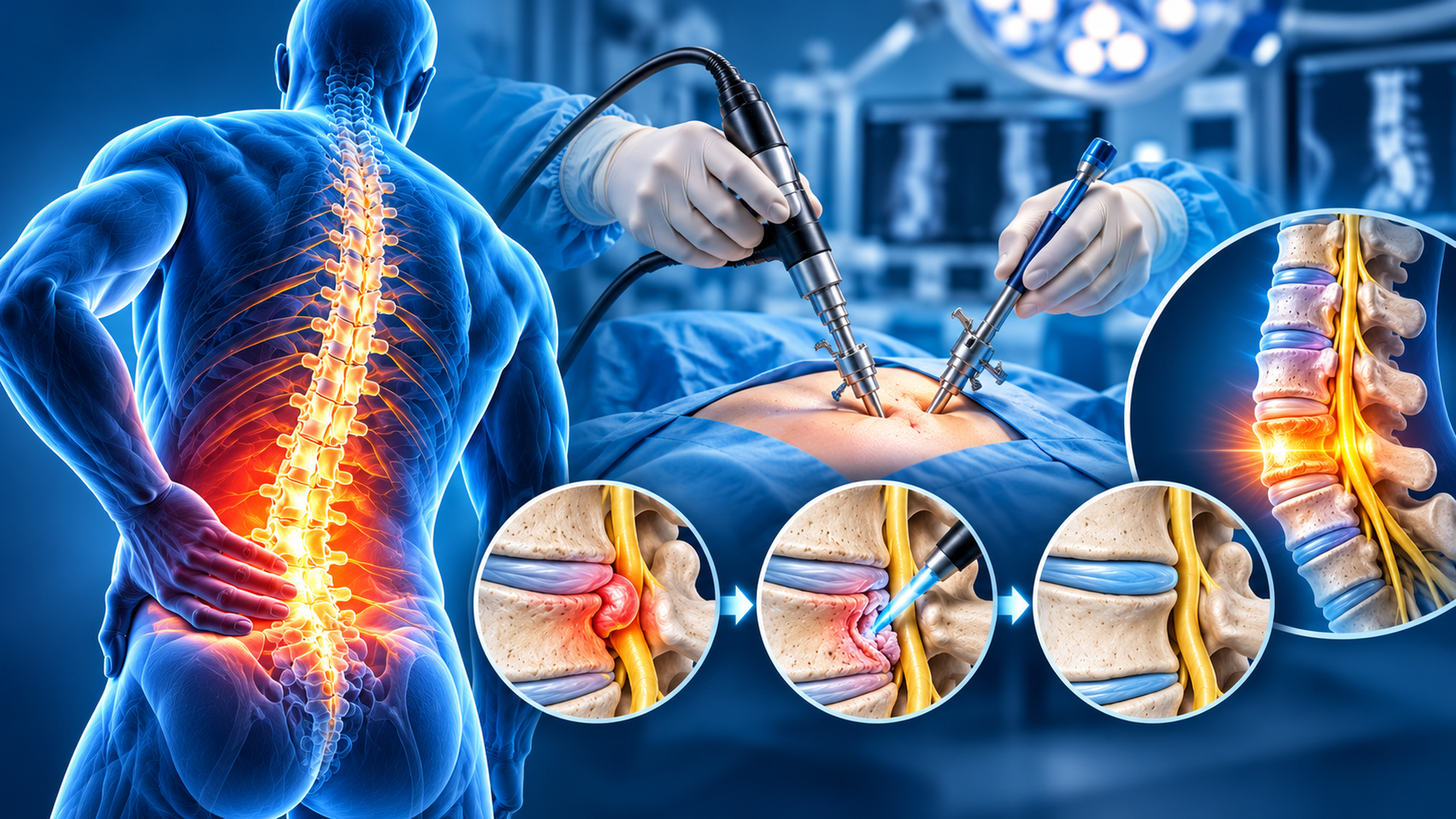
In traditional open spine surgery, the surgeon makes a long incision and moves the back muscles aside to reach the problem. Those muscles can be bruised or stretched, which is a major reason for post-operative pain and a long recovery. Minimally invasive spine surgery, also called keyhole spine surgery, takes a smarter route. Thin tubes or an endoscope pass between the muscle fibres instead of cutting through them, and the surgeon works with a high-magnification microscope or camera and live X-ray guidance.
The goal of the operation stays the same: remove whatever is pressing on the nerve, whether that is a disc fragment or a thickened ligament, and stabilise the spine when needed. What changes is the collateral damage. That is why the phrase chhota cut, jaldi recovery sums up the idea so well.
Open Surgery vs Minimally Invasive Spine Surgery
| Factor | Open Spine Surgery | Minimally Invasive Spine Surgery |
|---|---|---|
| Incision size | Long (often 8 to 15 cm) | Small (about 1 to 3 cm in many procedures) |
| Muscle damage | More muscle stripping | Muscle fibres are gently separated |
| Blood loss | Higher | Usually lower |
| Hospital stay | Several days | Often 1 to 2 days for disc and decompression procedures |
| Post-operative pain | Moderate to high | Usually mild to moderate |
| Return to desk work | Several weeks | Often 2 to 4 weeks |
| Best suited for | Complex deformity, large tumours, many levels | Slipped disc, canal stenosis, selected fusions |
Please remember that MISS is not automatically “better” for everyone. It is a tool, and the right surgeon picks the right tool for your MRI, not for the brochure.
Conditions Treated with Minimally Invasive Spine Surgery
Are You a Candidate for Keyhole Spine Surgery?
Most spine problems do not need surgery. The majority of slipped discs improve with medicines, physiotherapy, posture correction and time. Surgery enters the conversation only in specific situations. The decision is always made after a clinical examination and MRI, never on pain alone.
You May Be a Good Candidate If
- Leg or arm pain persists despite 6 to 12 weeks of proper conservative treatment
- MRI shows a nerve being compressed at a level that matches your symptoms
- You have growing weakness, foot drop or constant numbness
- Pain stops you from walking, sleeping or working
- You want a faster recovery and are medically fit for anaesthesia
Go to a Spine Surgeon Immediately If
- You lose control of urine or stool
- Numbness develops around the groin or inner thighs
- Weakness in a leg is worsening fast
- Back pain follows a major fall or accident
- Back pain comes with fever or unexplained weight loss
The first group means surgery is worth discussing. The second group is an emergency, because delay can cause permanent nerve damage. If you are unsure which group you belong to, read our overview of minimally invasive spine surgery or call the clinic.
Common Types of Minimally Invasive Spine Procedures
“MISS” is an umbrella term. The actual operation depends on your diagnosis. Your surgeon may discuss options such as:
- Microdiscectomy: a small portion of the herniated disc pressing on the nerve is removed under a microscope through a tiny incision.
- Endoscopic discectomy: the same goal, but performed through a narrow tube with a camera, often through an even smaller opening.
- Minimally invasive decompression (laminotomy): a small window of bone or thickened ligament is removed to open space for the nerve in spinal stenosis.
- Minimally invasive fusion: screws and rods are placed through small incisions to stabilise a slipped or unstable vertebra.

Not every clinic offers every technique, and that is fine. What matters is that the procedure matches the problem. A good surgeon will explain why a particular method suits you and also when open surgery is the safer choice.
Recovery After Minimally Invasive Spine Surgery: What to Expect
Recovery is the question patients worry about most, and rightly so. Timelines differ from person to person, but the following is a realistic general picture for disc and decompression procedures. Fusion takes longer.
Recovery Tips from Our Clinic
- Walk a little several times a day. Lying in bed for weeks slows recovery.
- Follow the “no BLT” rule for the first weeks: no Bending, Lifting or Twisting.
- Sit with a straight back and use a firm chair, especially if you commute across Gurgaon or Delhi.
- Complete your physiotherapy. Strong core muscles protect the operated level.
- Attend every follow-up so small problems are caught early.
For fusion surgery, routine activity may take 6 to 12 weeks, while the bone keeps fusing for several months. Smoking, uncontrolled diabetes and obesity slow healing, so improving them before surgery improves your result.
Minimally Invasive Spine Surgery Cost in Gurgaon
Everyone asks, “Kitna kharcha aayega?” Honestly, no responsible doctor can quote an exact figure over a phone call. Price lists on aggregator websites show wide ranges because they mix very different procedures and hospitals. The cost of minimally invasive spine surgery in Gurgaon is shaped by the following factors:
| Cost Factor | Why It Matters |
|---|---|
| Type of procedure | A single-level discectomy costs less than a multi-level fusion |
| Number of spine levels | More levels mean more operating time and materials |
| Implants | Screws, rods and cages add to the bill in fusion surgery |
| Hospital and room category | General, semi-private or private rooms are charged differently |
| Length of stay | Short-stay MISS often reduces total hospital charges |
| Investigations and medicines | MRI, blood tests, anaesthesia and post-operative care |
| Insurance | Cashless approval, co-pay and sub-limits vary by policy |
Smart Questions to Ask Before You Book
- Is surgery really necessary now, or can I try non-surgical treatment first?
- Which exact procedure do you recommend, and why this one?
- What is the all-inclusive estimate, and what could change it?
- How long will I stay in hospital and when can I go back to work?
- What are the risks in my specific case?
A clear estimate is possible only after your MRI is reviewed. Bring your reports, and we will explain the plan and the likely expenses before you decide anything.
Risks and Honest Expectations
Every operation carries risk. Although smaller incisions lower some risks, such as wound infection and blood loss, minimally invasive spine surgery can still involve nerve irritation, dural tear, persistent pain, recurrence of a disc herniation or, rarely, the need for another procedure. Success depends on choosing the right patient for the right operation. Surgery fixes the pressure on the nerve, but it cannot undo years of poor posture or inactivity, which is why rehabilitation matters.
For general background on spine conditions you can also read the Mayo Clinic overview of herniated disk, the NHS guide to back pain and the WHO fact sheet on low back pain.
Why Choose Dr. Vikas Kathuria for Spine Surgery in Gurgaon?
Dr. Vikas Kathuria (MBBS, MS, M.Ch Neurosurgery) is a Senior Consultant at Max Hospital, Gurgaon, with over 25 years of experience in brain and spine surgery. Patients value his clear explanations, careful diagnosis and his habit of recommending the least invasive option that will really work. As one patient wrote, his aunt was cured with nerve block injections and medicines when other doctors had advised surgery. That is the balanced approach we follow: surgery only when it is truly needed.
Spine Care for Patients in Gurgaon and Delhi NCR
Our clinic is at DLF Phase IV, Gurugram, close to Huda City Centre Metro Station, so it is easy to reach from Golf Course Road, Sohna Road, Sector 56 and the rest of Gurgaon. Many patients also travel from Delhi, Noida, Faridabad and Dwarka for a second opinion on minimally invasive spine surgery in Delhi NCR. If you live far away, you can share your MRI reports on WhatsApp first so that we can guide you on the next step.

Frequently Asked Questions About Minimally Invasive Spine Surgery
1. What is minimally invasive spine surgery?
Minimally invasive spine surgery treats spine problems through a small incision using special instruments, a microscope or an endoscope. It disturbs less muscle than open surgery, which usually means less pain, less blood loss and a faster return to routine.
2. How long is the recovery after minimally invasive spine surgery?
For decompression and disc procedures, many patients walk the same or next day and return to desk work in about 2 to 4 weeks. Fusion procedures take longer, often 6 to 12 weeks for routine activity, while the bone continues to fuse for several months. Recovery depends on the procedure, age and overall health.
3. What is the cost of minimally invasive spine surgery in Gurgaon?
There is no single fixed price. The cost depends on the condition, the number of spine levels, the type of procedure, implants, hospital room category, stay and your insurance. A detailed consultation with MRI review gives an accurate estimate.
4. Is minimally invasive spine surgery better than open surgery?
For suitable patients, MISS often means smaller scars, less muscle damage and a shorter hospital stay, with outcomes comparable to open surgery. However, some complex deformities, tumours or multi-level problems still need open surgery. Your surgeon recommends the approach that is safest for your condition.
5. Who is a good candidate for keyhole spine surgery?
Patients with a slipped disc, sciatica or spinal stenosis who have not improved after several weeks of medicines and physiotherapy, or who have weakness, numbness or bladder or bowel changes, may be candidates. Suitability is confirmed only after clinical examination and MRI.
6. Is minimally invasive spine surgery painful?
It is performed under anaesthesia, so you feel no pain during surgery. Afterwards, discomfort at the small incision is usually mild to moderate and is controlled with medicines. Most patients report much less pain than after open surgery.
7. Does health insurance cover minimally invasive spine surgery?
Most health insurance policies cover medically necessary spine surgery, but terms, sub-limits and waiting periods differ by policy. Check your policy and the pre-authorisation process with the hospital before admission.
8. How do I book a consultation for spine surgery in Gurgaon?
You can call +91-8377080260 or +91-9215151260, or use the appointment form on the website. Bring your MRI films and previous reports. The clinic is at DLF Phase IV, Gurugram, near Huda City Centre Metro Station.
Back or Leg Pain Not Settling? Get a Clear Second Opinion.
Consult Dr. Vikas Kathuria at Kathuria Brain & Spine Neuro Centre, DLF Phase IV, Gurugram. Mon to Sat: 10:30 AM to 12:30 PM and 6:00 PM to 7:30 PM. Sunday: 10:00 AM to 2:00 PM.
Looking for more reading? Browse our neurosurgery blog for guides on slip disc, neck pain, stroke and brain conditions.
Disclaimer: This article is for general education and is not a substitute for medical advice. Treatment decisions must be based on a personal examination and investigations by a qualified doctor.
- Back Pain Treatment Gurgaon
- Best Neurosurgeon in Gurgaon
- best spine surgeon Gurgaon
- brain and spine surgeon Gurgaon
- cervical spine surgery Gurgaon
- Dr Vikas Kathuria
- endoscopic spine surgery Gurgaon
- kamar dard ka ilaj Gurgaon
- keyhole spine surgery Gurgaon
- lumbar spine surgery Gurgaon
- Max Hospital Gurgaon neurosurgeon
- microdiscectomy Gurgaon
- minimally invasive spinal fusion
- minimally invasive spine surgery cost Gurgaon
- minimally invasive spine surgery Delhi NCR
- minimally invasive spine surgery Gurgaon
- minimally invasive spine surgery recovery time
- MISS surgery Gurgaon
- neck pain treatment Gurgaon
- neurosurgeon in Gurgaon
- Sciatica Treatment Gurgaon
- slip disc surgery Gurgaon
- slipped disc treatment Delhi NCR
- spinal stenosis treatment Delhi NCR
- spine surgeon in Gurgaon
- spine surgery cost in Gurgaon
- spine surgery in Delhi NCR
- spine surgery recovery time
- spine surgery second opinion
- spine surgery without big cut