
Sciatica: Symptoms, Causes, Treatment & When Surgery Is Needed (Gurgaon & Delhi NCR Guide)
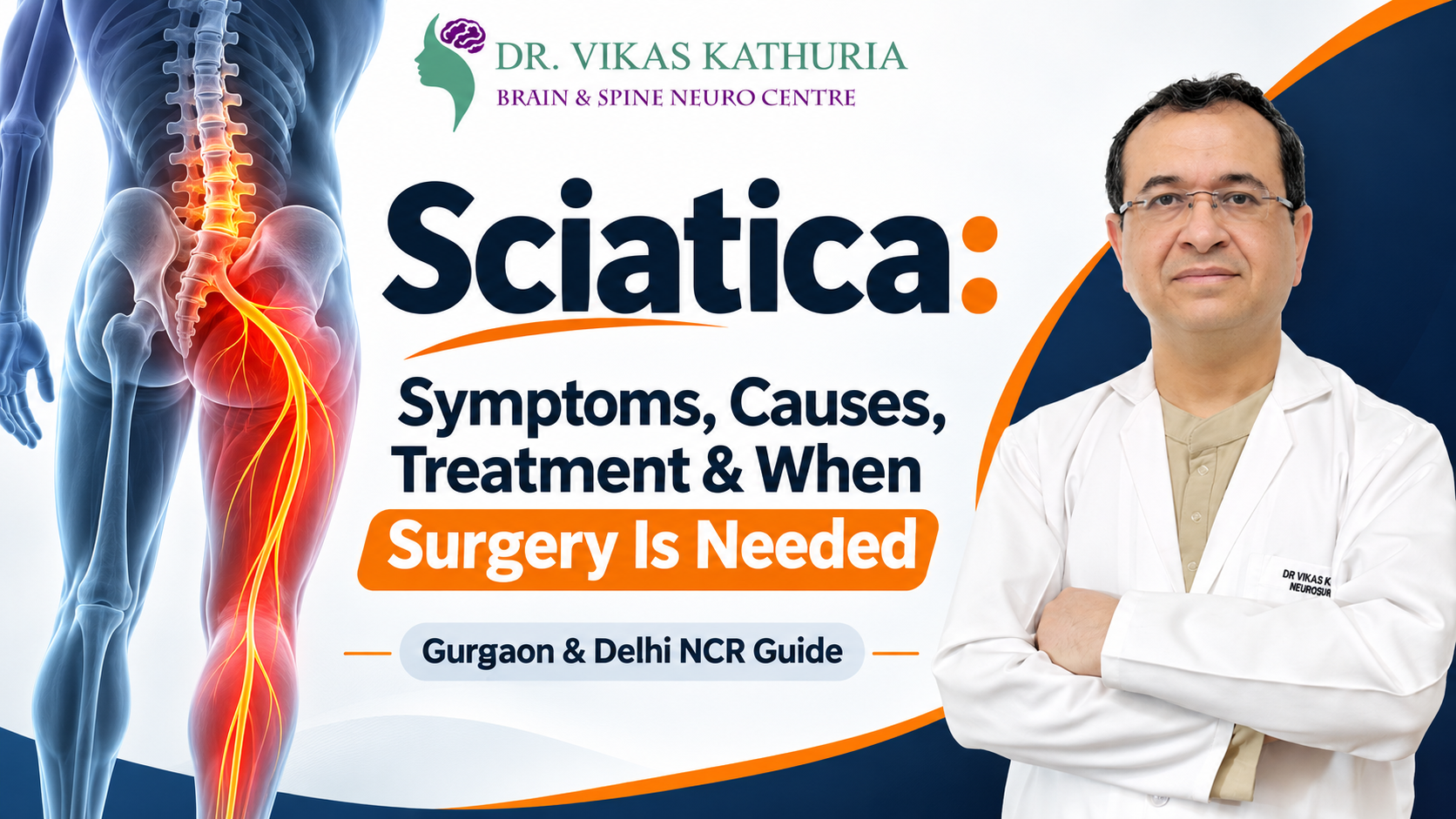
Spine Care | Gurgaon & Delhi NCR
By Dr. Vikas Kathuria, MBBS, MS, M.Ch (Neurosurgery) | Updated 14 November 2026
Quick Answer
Sciatica is pain, tingling or numbness that travels from the lower back or buttock down one leg. It happens when a nerve root in the lower spine is pressed or irritated, most often by a slipped (herniated) disc. Most people improve within weeks to a few months with gentle activity, physiotherapy and medicines. See a spine specialist if the pain has not eased after 4 to 6 weeks, and go to an emergency department at once if you have leg weakness with numbness around the groin or trouble controlling urine or stool.
If you have ever felt a sharp, electric pain shoot from your back down to your calf while getting out of a car, sitting through a long meeting, or bending to pick up your child, you already know how disruptive sciatica can be. In Gurgaon and across Delhi NCR, we see it in desk workers, drivers, two-wheeler riders, gym-goers and homemakers alike. The good news is that most cases settle without surgery. The important part is knowing which pain can be managed at home and which needs a specialist soon.
This guide explains sciatica in simple language: what it is, what causes it, the warning signs you must not ignore, how it is diagnosed, and when treatment moves from exercises and medicines to injections or surgery.
What Is Sciatica?
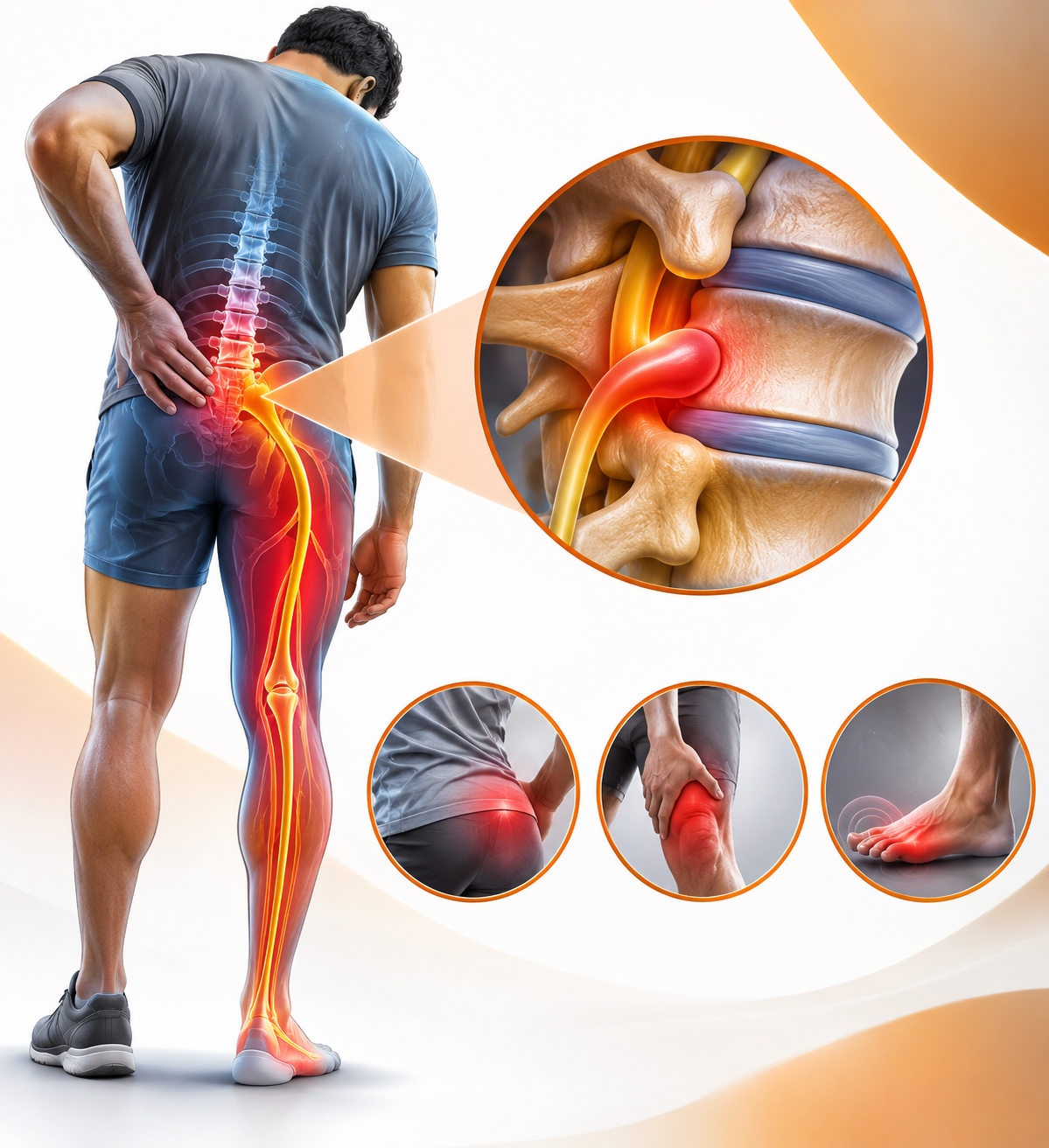
The sciatic nerve is the longest and thickest nerve in the body. It is formed by nerve roots that leave the lower spine, passes through the buttock and runs down the back of the thigh to the calf and foot. Sciatica is not a disease by itself. It is a symptom that tells you something is pressing on or irritating one of these nerve roots, usually in the lumbar (lower) spine.
That is why a plain painkiller may take the edge off but rarely solves the problem. Lasting relief depends on finding and treating the cause. If your pain is mainly in the back without leg symptoms, read our guide on back pain treatment in Gurgaon.
Common Symptoms of Sciatica
Sciatica usually affects one side of the body. You may notice:
- Pain that starts in the lower back or buttock and runs down the back or outer side of the leg, sometimes up to the foot or toes
- A sharp, burning or electric-shock type of pain, often worse than the back pain itself
- Tingling (pins and needles) or numbness in the leg, foot or toes
- Pain that increases with sitting, bending forward, coughing or sneezing
- Weakness in the leg or foot, such as difficulty lifting the front of the foot or climbing stairs
Mild sciatica can feel like a nagging ache. Severe sciatica can make it hard to stand, sleep or walk even a short distance.
What Causes Sciatica?
Anything that squeezes or inflames the nerve roots can cause sciatica. The most common causes are listed below.
| Cause | What happens | Typical clue |
|---|---|---|
| Slipped (herniated) disc | The soft centre of a disc pushes out and presses on a nerve root | Most common cause. Often between 30 and 50 years of age. Pain worsens on sitting or bending |
| Lumbar spinal stenosis | The spinal canal narrows, crowding the nerves | Leg pain or heaviness while walking that eases on sitting. More common after 50 |
| Spondylolisthesis | One vertebra slips forward over the one below | Back pain with leg pain, sometimes a feeling of instability |
| Piriformis syndrome | A deep buttock muscle irritates the nerve | Buttock pain that worsens with prolonged sitting. A sciatica-like condition |
| Injury or fracture | Trauma to the spine or pelvis | Pain that starts after a fall or accident |
| Rare causes | Spine tumour or infection | Night pain, fever, unexplained weight loss, history of cancer |
Spine conditions such as stenosis or a slipped disc in the lower back are often treated at our centre. You can read more on our page for lumbar spine surgery in Gurgaon.
Everyday Habits That Can Trigger or Worsen Sciatica
In our Delhi NCR practice, these factors come up again and again:
- Long hours of desk work or sitting in traffic between Gurgaon and Delhi
- Riding a two-wheeler on uneven roads, or driving long distances without breaks
- Lifting heavy weights at the gym or at home with poor technique
- Being overweight or smoking, both of which are linked with disc problems
- Staying inactive in cold weather. Many patients tell us their pain feels worse in winter because muscles tighten and movement reduces
Red Flags: When Sciatica Is an Emergency
Rarely, a large disc or other pressure on the lower nerves causes cauda equina syndrome, which can lead to permanent damage if not treated quickly. Go to a hospital emergency department immediately if you have sciatica along with any of these:
- Numbness around the groin, genitals or buttocks (the “saddle” area)
- New difficulty passing urine or controlling urine or stool
- Weakness or numbness in both legs, or leg weakness that is getting worse fast
- Sciatica on both sides
Also see a doctor promptly if back or leg pain comes with fever, unexplained weight loss, a history of cancer, a recent serious injury, or severe pain at night that does not ease with rest. These can point to infection or a growth in the spine, as explained on our spine tumor surgery page.
How Is Sciatica Diagnosed?
Diagnosis starts with listening to your story and a careful examination. Your doctor checks reflexes, muscle strength, sensation and a straight-leg-raise test, which shows whether lifting your leg reproduces the nerve pain.
- MRI of the lumbar spine: the most useful scan to see discs, nerves and the spinal canal. It is advised if pain lasts beyond about 6 weeks, if there is weakness, or if injections or surgery are being considered.
- X-ray: helps look at bone alignment, slippage or fractures.
- CT scan: used in selected cases, for example when MRI is not possible.
- Nerve conduction study / EMG: helps when the diagnosis is unclear or to confirm nerve damage.
Not every patient needs every test. Many people with mild sciatica improve without any scan, so tests are chosen based on your symptoms, not routinely.
Sciatica Treatment Without Surgery
Most sciatica improves with non-surgical care, and this is where treatment usually begins. The usual time frame is a few weeks to a few months.
1. Stay Gently Active
Short walks on level ground and light movement help recovery better than prolonged bed rest. Avoid sitting or lying in one position for too long. Take a short standing break every 30 to 40 minutes at work.
2. Physiotherapy and Targeted Exercises
A trained physiotherapist can teach nerve-gliding movements, core and hip strengthening, and posture correction. Do these exercises under guidance, since the wrong stretch can aggravate a slipped disc. General information on gentle exercises is also available on the NHS sciatica exercise page.
3. Medicines
Pain relievers, anti-inflammatory medicines and, in some patients, medicines for nerve pain can help while the nerve settles. These should be taken only as prescribed by your doctor, because long unsupervised use of painkillers carries its own risks.
4. Heat, Cold and Posture Care
Heat or cold packs can ease muscle spasm for comfort. Sit with proper lower-back support, keep your screen at eye level, and use a firm mattress. Sleep on your side with a pillow between the knees, or on your back with a pillow under the knees.
5. Epidural Steroid Injection or Nerve Root Block
If pain is severe and not controlled by the above, an image-guided injection near the affected nerve root can reduce inflammation and give a window for exercises to work. Relief varies from person to person and may not be permanent, so it is used as part of a plan and not as a standalone cure.
Sciatica: Myths vs Facts
| Myth | Fact |
|---|---|
| Complete bed rest is the best cure | Long rest can slow recovery. Gentle movement is usually better |
| Every sciatica patient needs surgery | The majority recover without surgery |
| Everyone must get an MRI on day one | Scans are for persistent pain, weakness or red flags |
| Strong massage or sudden spine cracking will fix it | These can worsen a disc problem. Get a diagnosis first |
| Back pain and sciatica are the same | Sciatica is nerve pain travelling down the leg, usually from a spine cause |
When Is Surgery Needed for Sciatica?
Surgery is not the first step. It is considered when:
- Severe leg pain continues despite proper non-surgical treatment for about 6 weeks or longer
- Leg or foot weakness is increasing, for example foot drop
- The pain makes daily life, work or sleep very difficult and the MRI clearly shows nerve compression that matches your symptoms
- There are signs of cauda equina syndrome (this is an emergency)
Surgical Options
- Microdiscectomy: through a small incision, the part of the disc pressing on the nerve is removed under magnification.
- Endoscopic or minimally invasive discectomy: in suitable patients, a very small opening is used, which can mean less tissue damage and a faster return to routine.
- Decompression (laminectomy or foraminotomy): creates more space for the nerve in spinal stenosis.
- Spinal fusion: reserved for selected cases with instability, such as spondylolisthesis.
Not every patient is a candidate for every technique. The choice depends on your MRI, symptoms, age and general health. To know how smaller-incision methods work, see our page on minimally invasive spine surgery in Gurgaon.
Recovery and How to Prevent Sciatica From Coming Back
Even after successful treatment, sciatica can return if the habits behind it stay the same. These steps lower the risk:
- Keep moving daily. Walking, swimming and cycling are gentle on the spine
- Strengthen your core and hip muscles with guided exercises
- Lift with your knees and hips, keeping the load close to your body
- Maintain a healthy weight and avoid smoking
- Set up an ergonomic workstation and avoid sitting for hours without a break
- After surgery, follow the activity and physiotherapy plan your surgeon gives you
For additional general information on sciatica from a public health source, you can also read the NHS guide to sciatica.
See a Neurosurgeon If
- Your leg pain has not improved after 4 to 6 weeks of proper self-care
- You have numbness, tingling or weakness in the leg or foot
- Pain is severe, keeps you awake at night or is getting worse
- Your MRI shows a disc prolapse or narrowing of the spinal canal
- You are being advised surgery and want a second opinion
Sciatica Treatment in Gurgaon at Kathuria Brain & Spine Neuro Centre
At our clinic near Huda City Centre Metro Station, Dr. Vikas Kathuria (MBBS, MS, M.Ch Neurosurgery), a senior consultant with over 25 years of experience in brain and spine care, evaluates each patient carefully before suggesting any treatment. Where possible, we first try medicines, physiotherapy and non-surgical options, and surgery is discussed only when it is truly required.
Book a Consultation for Sciatica and Back Pain
Kathuria Brain & Spine Neuro Centre
#7311, (Ground Floor & LGF), Behind DLF Super Mart 2, DLF Phase IV, Near Huda City Centre Metro Station, Gurugram, Haryana-122009
Phone: +91-8377080260 / +91-9215151260
Email: care@sabclinic.com
Mon to Sat: 10:30 AM to 12:30 PM and 6:00 PM to 7:30 PM | Sunday: 10:00 AM to 2:00 PM
Frequently Asked Questions About Sciatica
What is the fastest way to get relief from sciatica pain?
There is no instant cure, but most people feel better by staying gently active, avoiding long periods of sitting or lying down, using heat or cold packs for comfort, and taking medicines only as advised by a doctor. Physiotherapy-guided exercises help the nerve settle. If the pain is severe, keeps getting worse, or comes with weakness or numbness, see a spine specialist instead of waiting.
How long does sciatica last?
Many people improve within a few weeks to a few months. Some take longer, and the pain can return later, especially if the cause (such as a disc problem or poor posture) is not addressed. If your symptoms have not improved after 4 to 6 weeks of proper self-care, get a detailed evaluation.
Is walking good for sciatica?
Yes, gentle walking on flat ground is usually helpful because movement keeps the spine and nerve mobile and prevents stiffness. Walk at a comfortable pace and stop if leg pain or numbness clearly increases. Long bed rest is not recommended.
What is the difference between sciatica and a slipped disc?
A slipped (herniated) disc is a problem in the spine, while sciatica is the symptom, which is nerve pain travelling down the leg. A slipped disc in the lower back is the most common cause of sciatica, but spinal stenosis, spondylolisthesis, injury and other conditions can cause it too.
Do I need an MRI for sciatica?
Not always. Many cases improve without any scan. An MRI of the lumbar spine is usually advised if pain continues beyond 6 weeks, if there is leg weakness or foot drop, if you are considering an injection or surgery, or if red-flag symptoms are present.
When is surgery needed for sciatica?
Surgery is considered when severe leg pain continues despite proper non-surgical treatment, when muscle weakness is increasing, or in an emergency such as cauda equina syndrome. The choice of procedure, such as microdiscectomy or decompression, depends on the MRI findings and your overall health.
Can sciatica cause permanent damage?
Most sciatica does not cause permanent damage. However, severe or prolonged nerve compression can lead to lasting weakness, numbness or foot drop, and cauda equina syndrome can cause permanent bladder, bowel and leg problems if not treated urgently. This is why warning signs should never be ignored.
Which doctor should I see for sciatica, an orthopaedic doctor, a neurosurgeon or a physiotherapist?
A physiotherapist is a good first step for mild sciatica without warning signs. If you have persistent pain, numbness, weakness, or a scan showing nerve compression, a neurosurgeon or spine specialist can assess whether you need injections or surgery. In Gurgaon, you can book a consultation with Dr. Vikas Kathuria for a complete spine and nerve evaluation.
Disclaimer: This article is for general education and is not a substitute for a doctor’s advice, diagnosis or treatment. Symptoms and treatment differ from person to person. If you have red-flag symptoms, seek emergency medical care immediately.
- Back Pain Treatment Gurgaon
- Best Neurosurgeon in Gurgaon
- cauda equina syndrome
- Delhi NCR spine treatment
- Dr Vikas Kathuria
- endoscopic discectomy
- Gurgaon neuro spine centre
- herniated disc
- leg pain and numbness
- lumbar disc herniation
- Lumbar Spine Surgery
- microdiscectomy
- Minimally Invasive Spine Surgery
- neurosurgeon in Gurgaon
- sciatic nerve pain
- sciatica
- sciatica causes
- sciatica doctor in Gurgaon
- Sciatica Exercises
- Sciatica Pain Relief
- sciatica specialist Gurgaon
- sciatica surgery
- sciatica symptoms
- sciatica treatment
- sciatica treatment in Gurgaon
- slip disc treatment
- slipped disc sciatica
- spinal stenosis
- spine care
- spine surgeon in Gurgaon