
Brain Aneurysm Repair: Clipping vs Coiling, Symptoms & Recovery (Gurgaon, Noida & Delhi NCR Guide)
Quick Answer
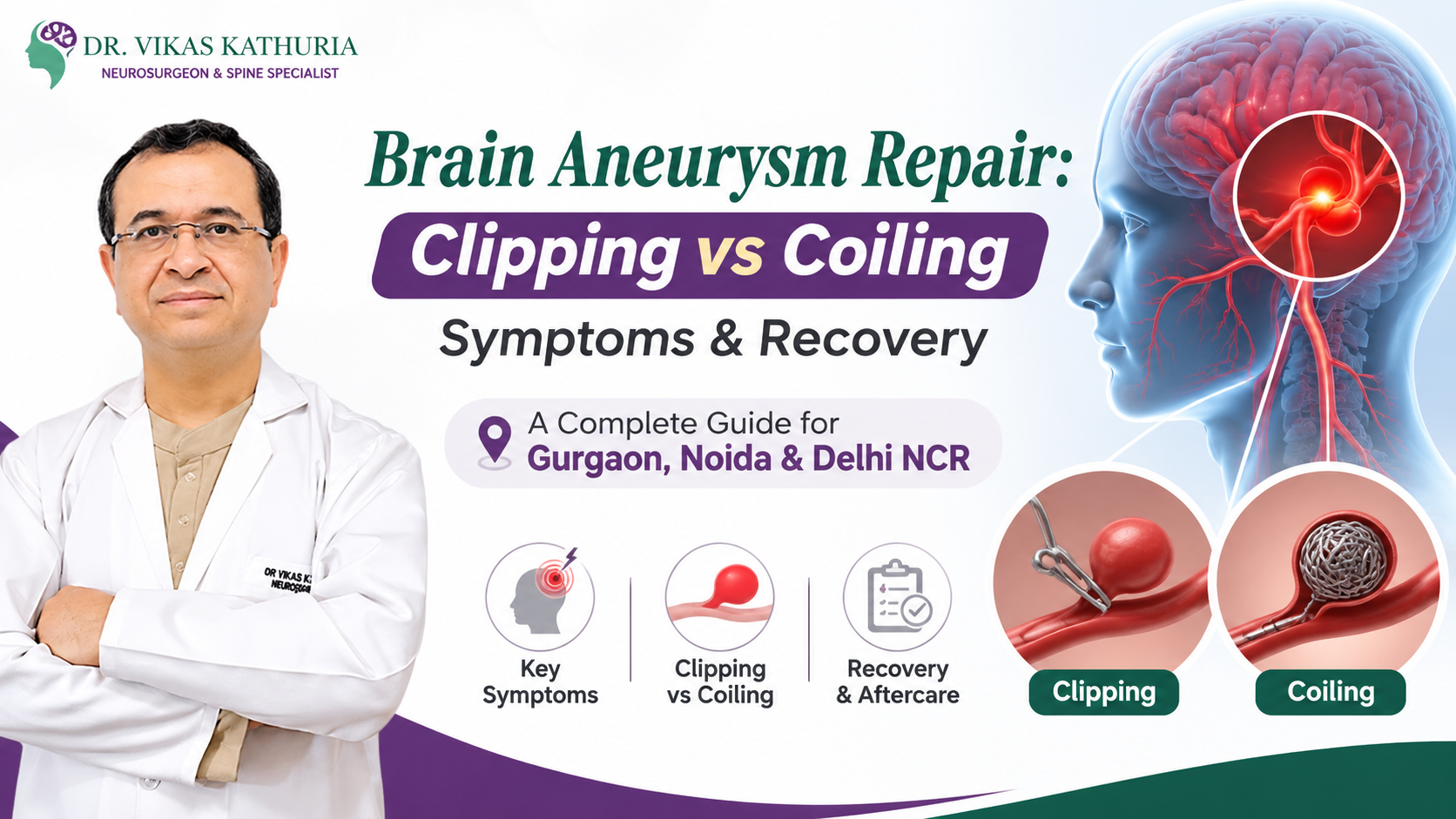
A brain aneurysm is a weak, bulging spot in a brain artery. Most never rupture, but a rupture causes bleeding around the brain and is a life-threatening emergency. The right brain aneurysm treatment in Gurgaon depends on size, location, shape, rupture status and your overall health. Options include regular monitoring, endovascular coiling, flow diversion and surgical clipping. Patients from Noida and across Delhi NCR can consult Dr. Vikas Kathuria for a clear, personalised plan.
Imagine a thin spot on a tyre that slowly bulges outward. For years it holds. Then, without warning, it gives way. A brain aneurysm behaves in a similar way, which is why doctors take it seriously even when it causes no symptoms at all. For families in Gurgaon, Noida and the wider Delhi NCR, the real questions are practical: Is my aneurysm dangerous? Does it need treatment? Should I choose clipping or coiling? How long is recovery? This guide answers each of them in plain language so that you can decide calmly and early.
What Is a Brain Aneurysm? (Simple Explanation)
A brain aneurysm, also called a cerebral or intracranial aneurysm, is a balloon-like swelling that forms where the wall of a brain artery has become weak. Blood pushes against this thin wall with every heartbeat, so the swelling can slowly grow. Many aneurysms are found by chance during an MRI or CT scan done for headaches or another reason.
Saccular (Berry) Aneurysm
The most common type. It looks like a berry hanging from a stem, usually at a branching point of an artery.
Fusiform Aneurysm
The artery widens on all sides, forming a spindle-shaped bulge rather than a single sac.
Infective (Mycotic) Aneurysm
A rare type caused when an infection elsewhere in the body weakens the artery wall.
The key point is simple. A brain aneurysm that has not ruptured can often be watched or treated in a planned way. One that has ruptured is a hemorrhagic stroke and needs emergency care. You can read more about this on our brain hemorrhage treatment page.
Brain Aneurysm Symptoms: Warning Signs You Must Not Ignore
Symptoms depend on whether the aneurysm is intact or has burst. Many people live for years without knowing they have one.
Unruptured Aneurysm
- Often no symptoms at all
- Pain behind or above one eye
- Double or blurred vision
- A dilated pupil or drooping eyelid
- Numbness or weakness on one side of the face
Ruptured Aneurysm
- Sudden, explosive headache, the “worst headache of life”
- Nausea and repeated vomiting
- Stiff neck and sensitivity to light
- Seizure or confusion
- Fainting or loss of consciousness
Emergency: Achanak Sabse Tez Sir Dard
If a headache reaches its worst intensity within seconds, treat it as an emergency. Do not wait to see if it settles and do not drive yourself. Call for an ambulance and go to the nearest hospital with neurosurgery and CT facility. Quick treatment in the first hours can protect life and brain function. A sudden “thunderclap” headache is different from a regular migraine or tension headache.
Some patients also report a milder “warning” headache days before a major bleed. If you notice a new, unusually severe headache pattern, get it checked through our headache pain treatment service rather than relying on painkillers.
Causes and Risk Factors: Who Is More at Risk in Delhi NCR?
Aneurysms develop when blood flow stress slowly damages a weak artery wall. Several factors raise the chance:
- High blood pressure, which is common and often untreated among working adults in Gurgaon and Noida.
- Smoking and tobacco use, which damage artery walls and speed up growth.
- Family history of aneurysm or brain hemorrhage.
- Age above 40 and female gender, according to published medical references.
- Inherited conditions such as polycystic kidney disease or connective tissue disorders.
- Head injury, infection or heavy alcohol use in some cases.
Cold weather and pollution can add stress to blood vessels, so risk awareness matters more in winter. See our guides on winter stroke and hemorrhage risk and Delhi NCR smog and brain health.
How Is a Brain Aneurysm Diagnosed?
Accurate imaging decides everything, because the size, neck width and exact position of the aneurysm guide the treatment. Common tests include:
- CT scan of the brain: the first test in an emergency to detect bleeding.
- CT angiography (CTA): a quick scan that maps the blood vessels in detail.
- MR angiography (MRA): useful for screening and follow-up without radiation.
- Digital subtraction angiography (DSA): the gold standard for a precise 3D view of the aneurysm before treatment.
Brain Aneurysm Treatment Options in Gurgaon
Not every aneurysm needs an operation. Doctors weigh the risk of rupture against the risk of the procedure. A ruptured aneurysm always needs urgent treatment. For unruptured ones, the plan may be one of the following.
1. Observation With Regular Imaging
Small, stable and symptom-free aneurysms, often under about 7 mm, may be monitored with periodic MRA or CTA while blood pressure and smoking are controlled. Treatment is advised sooner if the aneurysm grows, changes shape or starts causing symptoms.
2. Endovascular Coiling
A thin catheter is passed through an artery, usually from the groin, up to the aneurysm. Soft platinum coils are packed inside to seal it off from blood flow. There is no skull opening, so hospital stay is usually shorter. Some wide-necked aneurysms need a balloon or stent for support.
3. Flow Diversion
For certain large or complex aneurysms, a fine mesh stent is placed in the parent artery. It redirects blood away from the bulge and lets the aneurysm gradually shrink and close.
4. Surgical Clipping
Under general anaesthesia, a small opening is made in the skull and a tiny titanium clip is placed across the neck of the aneurysm. The clip stays permanently and gives a direct, durable seal. It is often chosen for aneurysms with a difficult shape or location, or when coiling is not suitable.
Clipping vs Coiling: Which Is Better?
Neither is “better” for everyone. The decision is made case by case after studying the angiogram.
| Factor | Endovascular Coiling | Surgical Clipping |
|---|---|---|
| Approach | Through an artery, no skull opening | Small skull opening (craniotomy) |
| Hospital stay | Usually shorter | Usually longer |
| Early recovery | Generally quicker | Slower, but steady |
| Durability | May need follow-up imaging, sometimes repeat treatment | Very durable seal in suitable aneurysms |
| Best suited for | Narrow-necked aneurysms in accessible locations | Complex shapes, wide necks, certain locations, or when a clot needs removal |
Doctor’s Approach
Dr. Vikas Kathuria reviews your scans, explains each option honestly and coordinates the plan with the hospital’s neurointerventional and critical care team, so the choice is based on your aneurysm and not on a fixed routine.
Why Consult Dr. Vikas Kathuria for Brain Aneurysm Repair

Dr. Vikas Kathuria (MBBS, MS, M.Ch Neurosurgery) has over 25 years of experience and is a senior consultant in neurosurgery at Max Hospital, Gurgaon. He consults patients at two convenient Gurugram locations: Qutub Plaza (DLF Phase 1) and South Point Mall (DLF Phase 5). Patients value him for clear explanations, accurate diagnosis and a personalised treatment plan.
Clear Second Opinion
Bring your CT or MRA report and get a plain explanation of whether treatment is needed now or later.
Complete Brain Care
Support for related conditions such as brain stroke and head injury.
Guided Follow-Up
Planned imaging, blood pressure advice and recovery guidance after treatment.
Learn more on the doctor profile page or visit the main brain aneurysm repair service page.
Questions to Ask Before Brain Aneurysm Treatment
- What is the size, neck width and location of my aneurysm, and what is its rupture risk?
- Is observation safe for me, or is brain aneurysm repair advised now?
- Why is clipping or coiling better for my aneurysm?
- What are the risks of the procedure, and how long will the ICU and hospital stay be?
- What follow-up scans will I need, and when can I return to work?
Writing these down and carrying them to your consultation helps you take part in the decision with confidence, especially if you are travelling from Noida or another part of Delhi NCR.
Recovery After Brain Aneurysm Repair: What to Expect
Recovery differs between a planned repair of an unruptured aneurysm and an emergency repair after a bleed. The usual pattern looks like this:
- First days: monitoring in the intensive care unit for blood pressure, neurological status and scan checks.
- Hospital stay: typically a few days after coiling and somewhat longer after clipping, depending on how you progress.
- After a rupture: doctors watch closely for complications such as vasospasm, where brain arteries narrow, in the days after bleeding.
- Weeks 2 to 6: gradual return to light daily routine, with rest, walking and no heavy lifting or straining.
- Follow-up: repeat imaging at intervals your surgeon advises, to confirm the aneurysm stays sealed.
Return to office work varies from person to person. Many patients recover well after planned treatment, while recovery after a ruptured aneurysm can take longer and may involve rehabilitation. Your surgeon will give a timeline based on your own case.
Living With an Aneurysm: Prevention and Follow-Up
- Keep blood pressure in the range your doctor advises and take medicines regularly.
- Stop smoking and avoid tobacco in every form.
- Limit alcohol and avoid recreational stimulants.
- Tell your doctor about any family history of aneurysm or brain bleed.
- Do not ignore a sudden severe headache, new double vision or facial numbness.
- Attend every follow-up scan, even if you feel completely fine.
For related reading, see our article on stroke in young adults.
Brain Aneurysm Treatment for Noida and Delhi NCR Patients
Our Clinic Locations in Gurugram
Qutub Plaza
423, 4th Floor, Qutab Plaza, Qutab Plz Road, DLF Phase-1, Sector 26A, Gurugram, Haryana, Pin 122002.
Appointments available from 15/11/2026.
South Point Mall
SPO-101A, First Floor, South Point Mall, DLF Phase 5, Sector 53, Gurugram, Haryana, Pin 122011.
Appointments available from 01/12/2026.
For Noida patients: both clinics are reachable by road or metro from Noida, Greater Noida, Delhi, Faridabad and Ghaziabad. Call or WhatsApp before you travel so that we can confirm the location and slot that suits you.
Travelling from abroad? Our international patient portal explains the pre-visit process, stay and follow-up.
Frequently Asked Questions
1. Does every brain aneurysm need surgery?
No. Small, stable, unruptured aneurysms are often monitored with regular scans. Treatment is advised based on size, location, shape, growth, symptoms and age. A ruptured aneurysm always needs urgent treatment.
2. Is clipping or coiling safer?
Both are effective and each carries risks. Coiling is less invasive, while clipping can be more durable in some aneurysms. Your surgeon recommends the option that suits your scan and health.
3. What is the first sign of a ruptured aneurysm?
A sudden, extremely severe headache, often with vomiting, stiff neck, fainting or seizure. It needs emergency care immediately.
4. How much does brain aneurysm treatment cost in Gurgaon?
Cost varies widely with the procedure, devices used, hospital room category, ICU stay and whether the aneurysm has ruptured. A consultation with your reports gives a realistic estimate.
5. How long is recovery after aneurysm repair?
Planned repairs usually mean a shorter stay and a return to routine over several weeks. Recovery after a rupture is longer and may need rehabilitation.
6. Can an aneurysm come back after treatment?
Coiled aneurysms can sometimes reopen, which is why follow-up imaging is important. New aneurysms can also form, especially if blood pressure or smoking is not controlled.
7. Can I travel from Noida for a consultation?
Yes. Many patients travel from Noida and other parts of Delhi NCR. Carry your CT, MRI or angiography films and reports for the visit.
Worried About a Brain Aneurysm Report?
Get an expert opinion before taking any decision. Call or WhatsApp for an appointment at our Gurugram clinics in Qutub Plaza or South Point Mall.
Further reading (external): Merck Manual: Brain Aneurysms | Harvard Health: The Worst Headache of Your Life
Disclaimer: This article is for general education and does not replace a medical consultation. If you have a sudden severe headache, go to the nearest emergency department immediately.
- aneurysm clipping surgery
- aneurysm coiling
- Best Neurosurgeon in Gurgaon
- brain aneurysm causes
- brain aneurysm cost Gurgaon
- brain aneurysm recovery
- brain aneurysm repair
- brain aneurysm surgery Gurgaon
- brain aneurysm symptoms
- brain aneurysm treatment Delhi NCR
- brain aneurysm treatment Gurgaon
- brain aneurysm treatment Noida
- Brain Hemorrhage Gurgaon
- brain surgeon Gurgaon
- cerebral aneurysm treatment
- clipping vs coiling
- Dr Vikas Kathuria
- endovascular coiling
- flow diverter aneurysm
- intracranial aneurysm
- Neurosurgeon Delhi NCR
- Neurosurgeon Gurgaon
- neurosurgeon Noida
- Qutub Plaza neurosurgeon
- ruptured brain aneurysm
- South Point Mall neurosurgeon
- subarachnoid hemorrhage
- thunderclap headache
- unruptured brain aneurysm
- worst headache of life