
Sir Mein Chot Lagne Ke Baad Kya Karein? Head Injury & Brain Bleed Guide (Gurgaon & Delhi NCR)
A slip in the bathroom, a bike skid, or a sudden brake in dense fog on the Dwarka Expressway: most people shrug off the knock and say, “Bas halki si chot hai.” Yet sir mein chot lagne ke baad kya karein is one of the most important questions a family can ask, because the first hours decide the outcome. Moreover, winter fog and cold waves cut visibility on NH48, the Dwarka Expressway and KMP, and road crashes remain a major cause of head injury across Gurgaon and Delhi NCR. However, a skull that looks fine can still hide a brain bleed. Therefore, this guide explains the danger signs, first aid, scans, surgery and where to find head injury treatment Gurgaon patients can reach quickly.
Quick Answer
After any head injury, keep the person still, support the neck, stop bleeding with gentle pressure and give no food or water. Go straight to the nearest hospital with a CT scan and neurosurgeon if there is vomiting, loss of consciousness, blood or fluid from the ear or nose, a seizure, confusion or a worsening headache. In short, do not wait for symptoms to “settle”.
In This Guide
- Warning signs you should never wait on
- First aid: what to do and what to avoid
- CT scan, EDH and SDH in simple language
- Surgery versus observation
- The 24-48 hour danger period and recovery
- Where to go in Gurgaon and Delhi NCR
- FAQs
Head Injury Symptoms: Warning Signs You Should Never Wait On
Many people look at the wound and judge the injury. However, that is a mistake. For example, a scalp cut can bleed heavily and be harmless, while a head that shows no mark can hide a clot. Our head injury treatment page explains this in detail. Therefore, treat the following as emergency signs and do not wait at home.
Repeated vomiting
Vomiting more than once after the blow can signal rising pressure inside the skull.
Behosh hona
Any loss of consciousness, even for a minute, or being hard to wake, needs a CT scan.
Blood or fluid from ear or nose
Clear or bloody fluid can mean a skull base fracture or a CSF leak.
Chidchidapan and confusion
Sudden irritability, restlessness, drowsiness, slurred speech or not recognising family are red flags.
Worsening headache
A headache that keeps getting stronger, or neck stiffness, needs urgent assessment.
Fits, weakness, vision change
Seizures, numb or weak limbs, unequal pupils or double vision point to brain involvement.
Children and elderly need extra care
For example, infants may show only persistent crying, refusing feeds, repeated vomiting or a bulging soft spot. Similarly, older adults, especially those on blood thinners, can develop a slow bleed days or weeks after a minor fall. These brain hemorrhage symptoms are easy to miss. Therefore, see our brain hemorrhage treatment page for the full list.
First Aid After a Head Injury: What to Do and What Not to Do
The first few minutes at the roadside or at home matter. First, stay calm, call 112 or ambulance 108 for any serious injury, and follow this simple checklist.
Do this
- Keep the person still and support the head and neck. Move them only if there is danger such as traffic or fire.
- Check breathing and response. If they vomit, turn the head, neck and body together as one unit.
- Press a clean cloth gently on a bleeding wound. If you suspect a skull fracture or see fluid from the ear, cover loosely instead.
- Apply a cold pack wrapped in cloth on a swollen bump.
- Note the time, how it happened and any blood thinners the person takes.
Avoid this
- Do not shake, slap or pull the person to wake them.
- Do not give water, tea or food, since surgery or anaesthesia may be needed.
- Do not give aspirin or ibuprofen, which can worsen bleeding. Ask a doctor before any painkiller.
- Do not remove an object stuck in the wound.
- Do not remove a helmet unless breathing is blocked and you are trained.
Myth: “The person must not sleep”
Sleep is fine once the person is alert and a doctor has assessed them. Instead, what matters is that an adult stays close for the first 24 hours and can wake them to check that they respond normally.
CT Scan, EDH and SDH in Simple Language
A CT scan after head injury takes only minutes and shows bleeding, skull fractures and swelling. Because of this, it is usually the first test, and MRI follows when subtle damage is suspected.
When a CT scan is strongly advised
In particular, doctors recommend a scan when there is:
- loss of consciousness, memory loss or confusion after the injury
- repeated vomiting, a seizure or a worsening headache
- age above 65, or use of blood thinners such as warfarin or clopidogrel
- a suspected skull fracture, or blood or fluid from the ear or nose
- a high-speed crash, a fall from height or intoxication that can hide symptoms
EDH vs SDH: the key differences
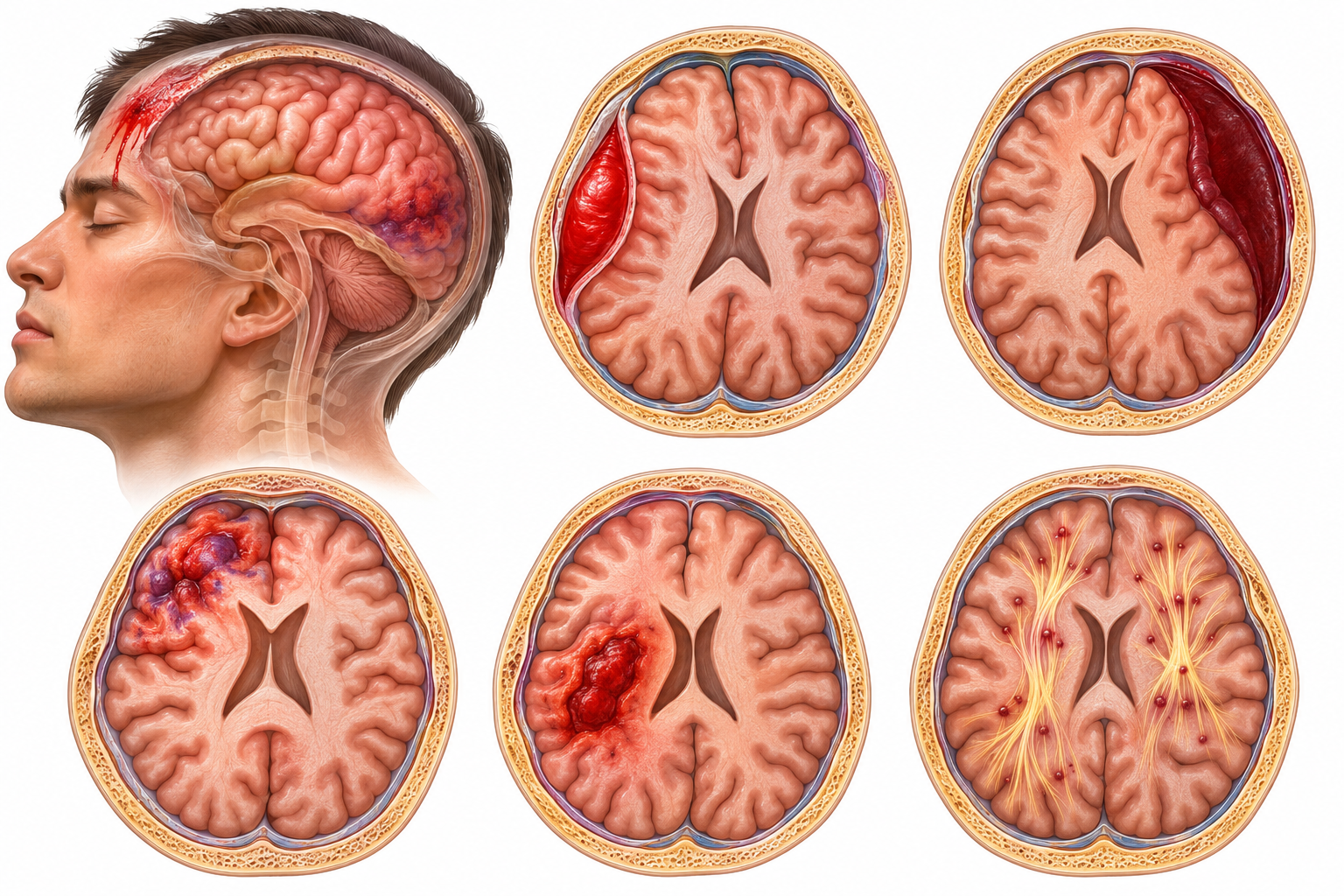
Meanwhile, two clots cause most surgical emergencies after trauma. Here is how they differ.
| Feature | EDH (Epidural Hematoma) | SDH (Subdural Hematoma) |
|---|---|---|
| Where the blood collects | Between the skull and the outer covering of the brain | Between the covering and the brain surface |
| Usual source | Torn artery, often with a skull fracture | Torn small veins |
| Typical story | Brief blackout, feels well, then rapid drowsiness | Acute after severe trauma, or chronic after a minor fall |
| Who is at risk | Young adults in road crashes | Older adults, alcohol users, people on blood thinners |
| Outlook | Very good when treated early | Depends on size, age and brain damage |
Head Injury Surgery: When It Is Needed and When Observation Is Enough
Observation is enough when
- the person is alert and the CT scan is normal or shows a very small bleed
- there is no weakness, fit or worsening drowsiness
- repeat checks or a repeat scan stay stable
Treatment is rest, monitoring, pain relief and sometimes anti-seizure medicine.
Surgery is considered when
- a clot is large, growing or pushing the brain to one side
- consciousness is falling or pressure inside the skull is rising
- there is a depressed skull fracture or a penetrating injury
Procedures include removing the clot (craniotomy), draining a chronic SDH, or repairing the skull.
The decision is never based on one number. Instead, a neurosurgeon weighs the scan, the person’s level of consciousness, age and medicines. For more detail, read about brain hemorrhage treatment in Gurgaon to see how each case is planned.
The First 24-48 Hours and Safe Recovery
Home watch checklist
- Stay with them: an adult should be nearby for the first 24 hours.
- Check regularly: they should wake easily, speak normally and walk steadily.
- Return to hospital at once for vomiting, increasing sleepiness, a stronger headache, a fit, weakness or clear fluid from the nose or ear.
- Rest the brain: limit screens, no alcohol, no driving and no contact sports until a doctor clears you.
Returning to normal life
Most people with a mild injury feel better within days to a few weeks, and then return to work in stages, starting with light half-days. However, after a bleed or surgery, recovery is longer, so your neurosurgeon will set the timeline. Also, persistent dizziness, memory trouble or headaches deserve a headache evaluation.
Head Injury Treatment Gurgaon: Where to Go in an Emergency in Delhi NCR
Four steps to take
- First, call 112 or 108 for a serious injury, and do not drive a drowsy or vomiting patient yourself if an ambulance can reach you.
- Next, choose the nearest hospital with a 24×7 emergency room, CT scan, ICU and neurosurgery cover. Do not lose precious time driving across the city to a “famous” name, because every minute counts.
- Then, tell the team the time of injury, any blood thinners, diabetes or earlier surgeries.
- Finally, follow up with a neurosurgeon for scan review, repeat imaging and rehabilitation advice.

Clinic and follow-up care
Dr. Vikas Kathuria, who is a senior consultant neurosurgeon at Max Hospital Gurgaon, guides patients from Gurgaon, Delhi, Faridabad, Noida and across NCR on head injury and brain bleed care. However, our clinic in DLF Phase IV is an OPD for consultation and follow-up and does not replace an ambulance or emergency room. Additionally, reading about winter stroke and hemorrhage risk or smog and brain health can also help your family stay prepared this season.
Prevent the next head injury
To reduce risk, wear an ISI-marked helmet and a seat belt, slow down in fog, use fog lamps, avoid night driving when tired, and fit grab bars and non-slip mats at home for elderly relatives. The WHO road traffic injuries fact sheet, the NHS head injury guide and the Mayo Clinic overview of traumatic brain injury offer further reading.
Frequently Asked Questions About Head Injury
1. Sir mein chot lagne ke baad kya karein?
Keep the person still, support the neck, stop bleeding with gentle pressure and give no food or water. Call 112 or 108 and reach the nearest hospital with a CT scan if there is vomiting, blackout, a fit, confusion or fluid from the ear or nose.
2. When is a CT scan necessary after a head injury?
A CT scan is needed after loss of consciousness, memory loss, repeated vomiting, a seizure, a worsening headache, age above 65, blood thinner use, a suspected skull fracture or a high-impact crash or fall.
3. What is the 24-48 hour danger period?
Bleeding inside the skull can start slowly, so symptoms may appear hours after the blow. For the first 24 to 48 hours an adult should watch the person and rush to hospital if drowsiness, vomiting, headache or weakness increases.
4. What are the brain hemorrhage symptoms after a head injury?
Common brain hemorrhage symptoms are a sudden or worsening headache, repeated vomiting, drowsiness, confusion, seizures, weakness on one side, slurred speech and unequal pupils. Older adults may show only mild confusion or personality change.
5. What is the difference between EDH and SDH?
EDH is a clot between the skull and the brain’s outer covering, usually from an artery, and can worsen fast. SDH lies beneath that covering, usually from veins, and is common in older adults, even after minor falls.
6. When does a head injury need surgery?
Surgery is considered for a large or growing clot, brain shift, falling consciousness, rising pressure, a depressed skull fracture or a penetrating wound. Small stable bleeds are often managed with close observation and repeat scans.
7. When can I go back to work after a head injury?
After a mild injury many people resume light work within days to a few weeks, starting with reduced hours. After a bleed or surgery the timeline is longer. Avoid driving and contact sports until your neurosurgeon clears you.
8. Should I see a neurologist or a neurosurgeon for a head injury in Gurgaon?
Start with the emergency team. A neurosurgeon is needed when the scan shows a bleed, fracture or swelling that may require surgery. A neurologist helps with headaches, seizures and long-term symptoms after recovery.
9. How much does head injury treatment cost in Gurgaon?
Cost depends on the injury, scans, ICU stay, surgery and hospital category. A mild injury needing only a CT scan costs far less than a bleed needing surgery, so ask the hospital for an estimate after the scan.
Need a head injury or brain bleed opinion in Gurgaon?
For emergencies, call 112 or 108 first. For consultation, scan review or follow-up with Dr. Vikas Kathuria, contact our clinic.
Kathuria Brain & Spine Neuro Centre, #7311, Behind DLF Super Mart 2, DLF Phase IV, Near Huda City Centre Metro Station, Gurugram 122009.
Mon-Sat 10:30 AM-12:30 PM and 6:00-7:30 PM | Sun 10:00 AM-2:00 PM

Dr. Vikas Kathuria
MBBS, MS, M.Ch (Neurosurgery) with 25 years of experience in brain and spine care. See more on brain stroke treatment and brain aneurysm repair, or read our earlier head injury article.
Disclaimer: This article is for education and is not a substitute for a doctor’s advice. In an emergency, go to the nearest hospital or call 112.
- Best Neurosurgeon in Gurgaon
- brain bleed treatment Gurgaon
- Brain Hemorrhage Gurgaon
- brain hemorrhage symptoms
- concussion symptoms
- craniotomy Gurgaon
- CSF leak after head injury
- CT scan after head injury
- Delhi NCR neurosurgeon
- Dr Vikas Kathuria
- EDH vs SDH
- epidural hematoma
- head injury 24 48 hours
- head injury doctor in Gurgaon
- head injury emergency Gurgaon
- head injury first aid
- head injury surgery
- head injury symptoms
- head injury treatment Delhi NCR
- head injury treatment Gurgaon
- neurosurgeon for head injury Gurgaon
- NH48 accident head injury
- road accident head injury
- sir mein chot ke baad kya karein
- skull fracture treatment
- subdural hematoma
- TBI treatment Gurgaon
- traumatic brain injury
- when to go to hospital after head injury
- winter fog accident head injury